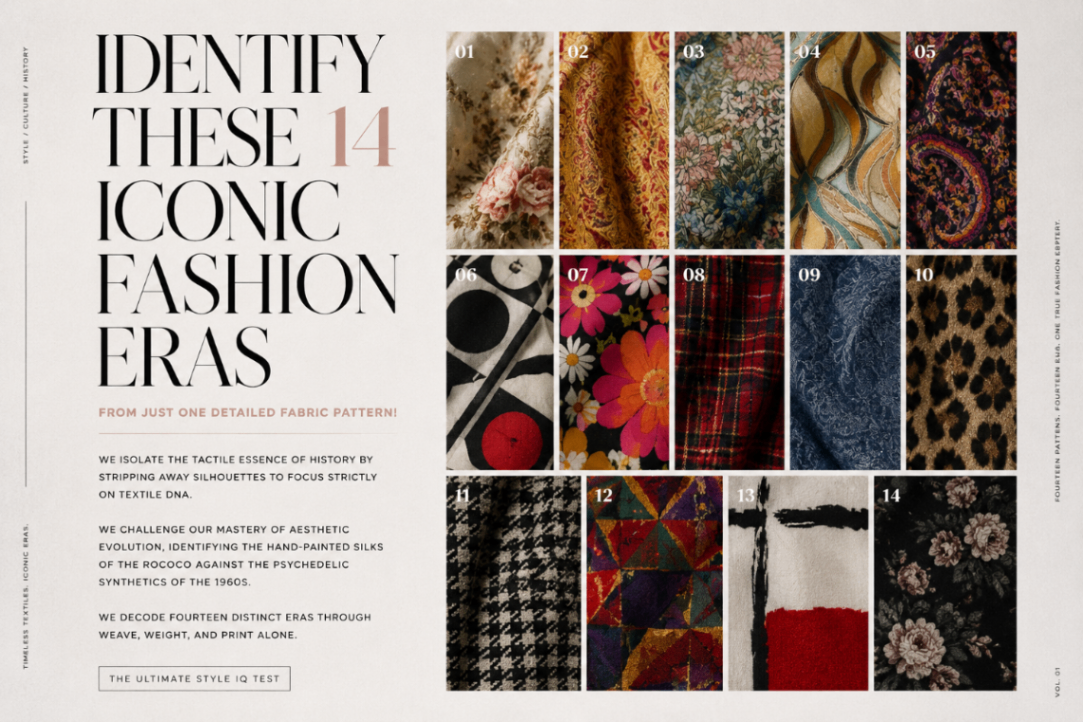
Questions in this quiz: Test Your Eye: Identify Fashion Eras by Fabric
- Which fabric pattern, featuring a teardrop-shaped motif with Persian origins, became a defining textile of the Kashmir shawls prized in Regency-era Europe? — Options: Paisley, Damask, Houndstooth, Ikat
- A repeating pattern of small broken checks in two contrasting colors, popularized in Scottish woven wool and later adopted by Christian Dior in the late 1940s, is known as what? — Options: Herringbone, Houndstooth, Tartan, Gingham
- Bold geometric zigzags, sunbursts, and stepped chevrons printed on silk crepe are most strongly associated with which fashion era? — Options: Victorian 1860s, Art Deco 1920s, New Look 1950s, Grunge 1990s
- A swirling, high-contrast black-and-white op-art print on synthetic jersey most likely dates from which decade? — Options: 1940s, 1960s, 1980s, 2000s
- Hand-painted pastoral scenes on lightweight silk taffeta, featuring shepherdesses and floral sprays, are hallmarks of which court's fashion? — Options: Elizabethan England, Rococo France, Meiji Japan, Weimar Germany
- A checked woolen pattern with named clan variants and horizontal/vertical stripe repeats is called what? — Options: Tartan, Madras, Seersucker, Toile
- A single-color pastoral scene printed on cotton — often blue or red on cream — depicting rural French life is known as what? — Options: Chintz, Toile de Jouy, Batik, Jacquard
- Kaleidoscopic swirls of hot pink, orange, and lime green on polyester knit fabric are most emblematic of which decade's mass fashion? — Options: 1930s, 1950s, 1970s, 1990s
- A resist-dyed fabric produced by applying wax to cloth before dyeing, traditionally associated with Java, is called what? — Options: Ikat, Batik, Shibori, Kalamkari
- A puckered striped cotton fabric, worn for warm-weather suits in the American South from the 1900s onward, is known as what? — Options: Seersucker, Poplin, Chambray, Muslin