Questions in this quiz: Comets
Comet structure (nucleus, coma, ion and dust tails), short- and long-period comets, the Oort Cloud and Kuiper Belt, Halley's Comet, Hale-Bopp, Shoemaker-Levy 9's Jupiter impact, and the Rosetta mission.
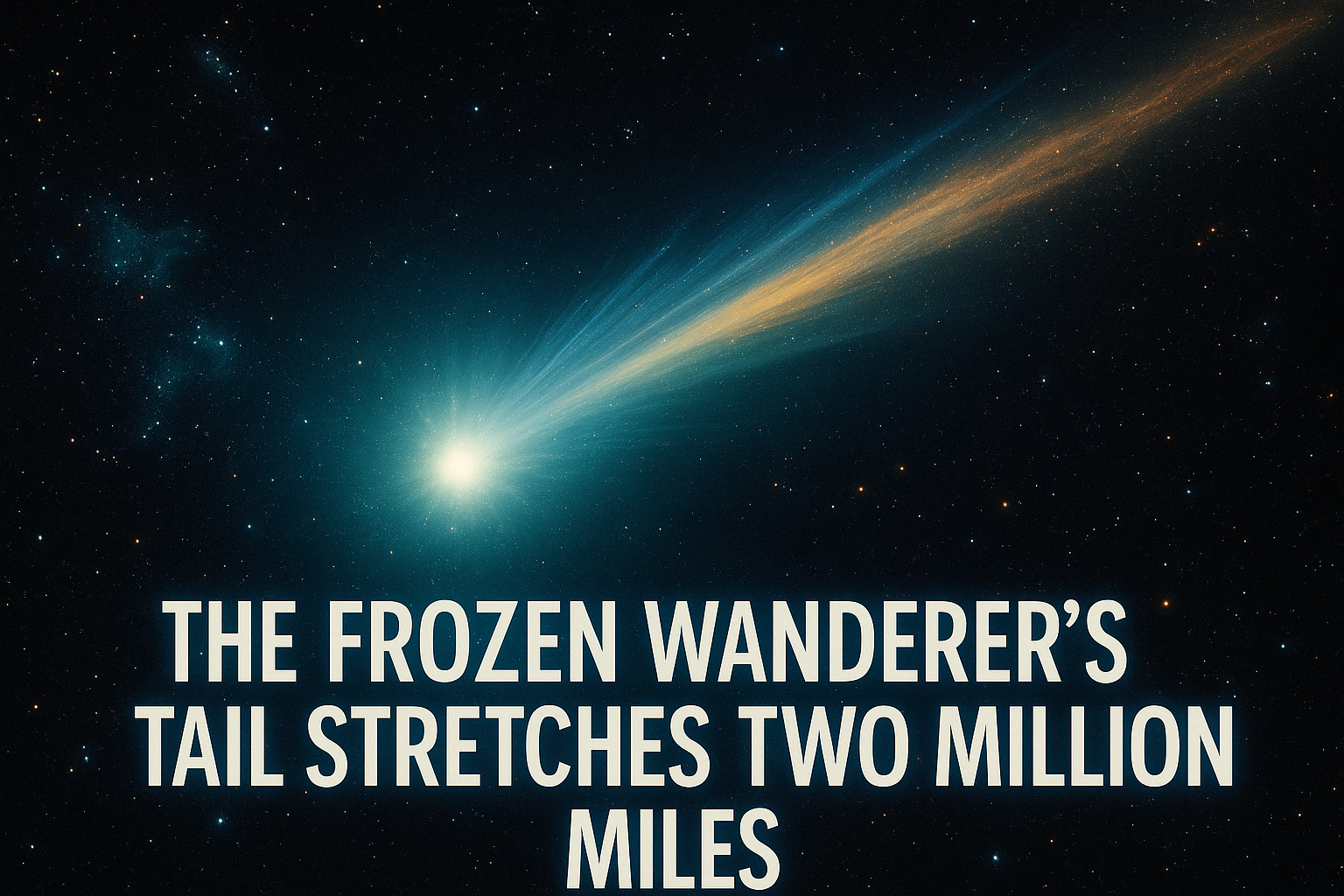
- The two tails of a comet point in different directions because they are shaped by different forces. Which statement correctly describes this difference? — Options: The dust tail curves along the orbit while the ion tail points directly away from the Sun, The ion tail curves along the orbit while the dust tail points directly away from the Sun, Both tails point away from the Sun but the dust tail is always longer, Both tails point along the direction of motion, opposite to the Sun
- Comets are conventionally classified as 'short-period' if their orbital period falls below a specific threshold. What is that cutoff? — Options: 20 years, 200 years, 2,000 years, 20,000 years
- The Oort Cloud is hypothesized to extend roughly how far from the Sun at its outer edge? — Options: 500 AU, 5,000 AU, 100,000 AU, 10 million AU
- In July 1994, fragments of Shoemaker-Levy 9 struck Jupiter over a period of several days. What had caused the comet to break into the chain of fragments before impact? — Options: A collision with one of Jupiter's small outer moons, Tidal forces during a close pass by Jupiter in 1992, Sublimation of volatile ices during a previous perihelion, An electromagnetic interaction with Jupiter's magnetosphere
- The Rosetta mission's Philae lander touched down on comet 67P/Churyumov-Gerasimenko in November 2014. Why did its landing not go according to plan? — Options: The descent thruster fired prematurely, causing it to overshoot the target site, The harpoons failed to fire and it bounced multiple times before settling, A dust jet from the nucleus knocked it off course during final descent, Communication with the orbiter was lost moments before touchdown
- Roughly what is the orbital period of the comet whose return Edmond Halley famously predicted by linking several historical apparitions? — Options: 46 years, 76 years, 112 years, 165 years
- Hale-Bopp became one of the brightest comets of the 20th century in 1996-97. Beyond its conventional ion and dust tails, what additional type of tail was detected from it for the first time? — Options: A tail of neutral sodium atoms, A tail of molecular oxygen, A tail of helium ions, A tail of carbon monoxide ice grains