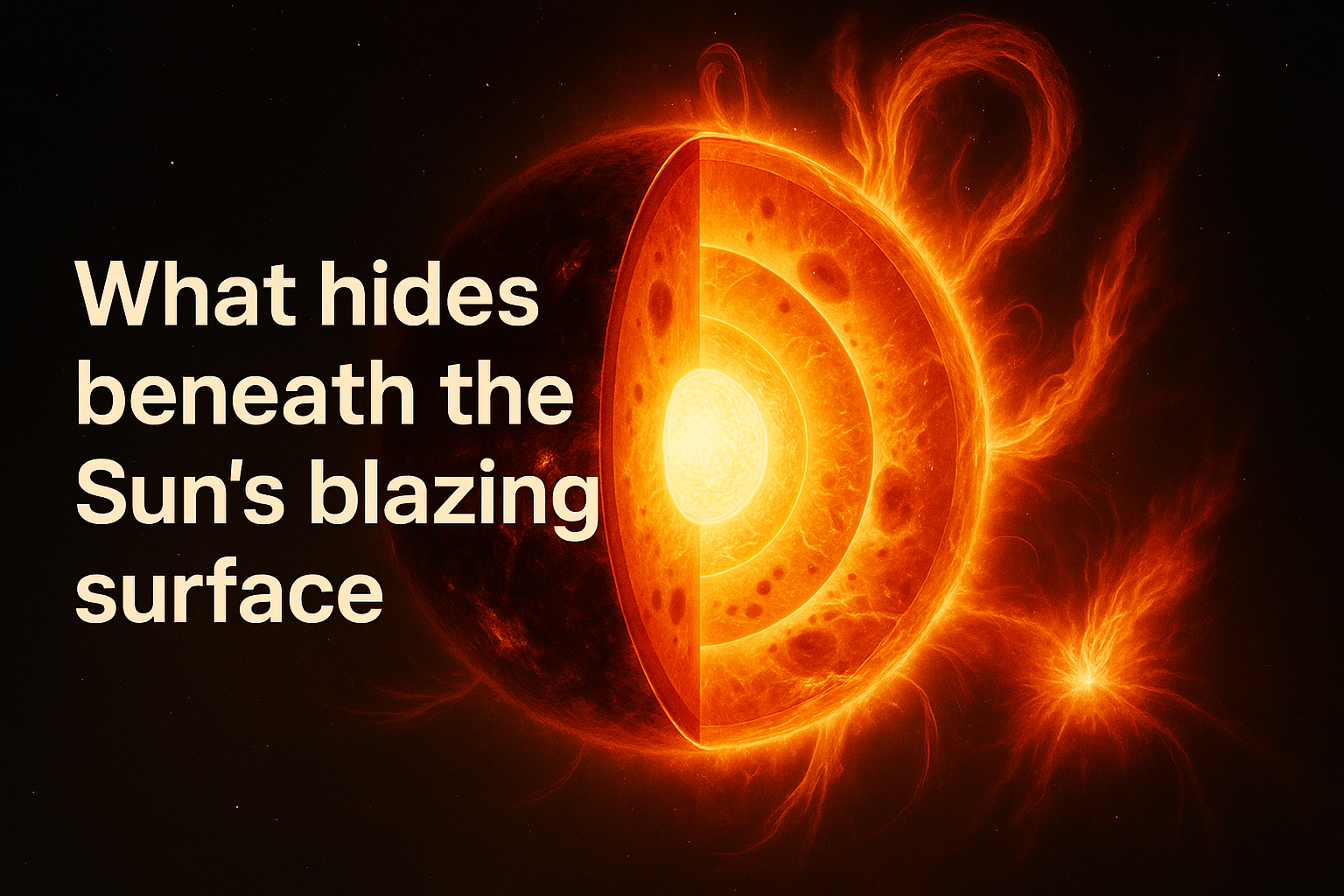
Questions in this quiz: The Sun
Our star. The core, radiative zone, convection zone, photosphere, chromosphere, and corona. Sunspots, solar flares, coronal mass ejections, the solar cycle, and the Sun's eventual fate.
- Energy generated in the Sun's core travels outward through the radiative zone primarily by what mechanism? — Options: Bulk fluid motion of ionized plasma, Repeated absorption and re-emission of photons by ions, Neutrino diffusion, Magnetic reconnection cascades
- Roughly what fraction of the Sun's total energy output is carried away by neutrinos rather than photons? — Options: About 0.1%, About 2%, About 10%, About 25%
- The temperature of the photosphere is around 5,800 K, yet the corona above it reaches over a million kelvin. What is the leading explanation for this temperature inversion? — Options: Compressional heating from infalling coronal rain, Dissipation of magnetic energy via nanoflares and Alfvén waves, Frictional heating from differential rotation at the tachocline, Latent heat released by ionization of hydrogen
- Sunspots appear dark in visible light primarily because: — Options: They are regions where the photosphere has temporarily thinned, exposing cooler layers below, Strong magnetic fields suppress convective heat transport, making them cooler than the surrounding photosphere, They contain a high concentration of dust and heavier elements that absorb light, They are points where coronal material has condensed and fallen back onto the surface
- The approximately 11-year sunspot cycle is actually half of a longer magnetic cycle. What distinguishes one 11-year half from the next? — Options: The latitude band where spots first appear shifts hemispheres, The polarity of leading and following spots in each hemisphere reverses, The Sun's overall luminosity alternates between two stable levels, The direction of differential rotation reverses at the equator
- During the late 17th century, sunspot activity dropped to almost nothing for roughly 70 years, coinciding with unusually cold winters in Europe. What is this period called? — Options: The Dalton Minimum, The Spörer Minimum, The Maunder Minimum, The Oort Minimum
- What is the typical travel time for a coronal mass ejection to reach Earth from the Sun? — Options: About 8 minutes, About 8 hours, Between 1 and 3 days, About 2 weeks