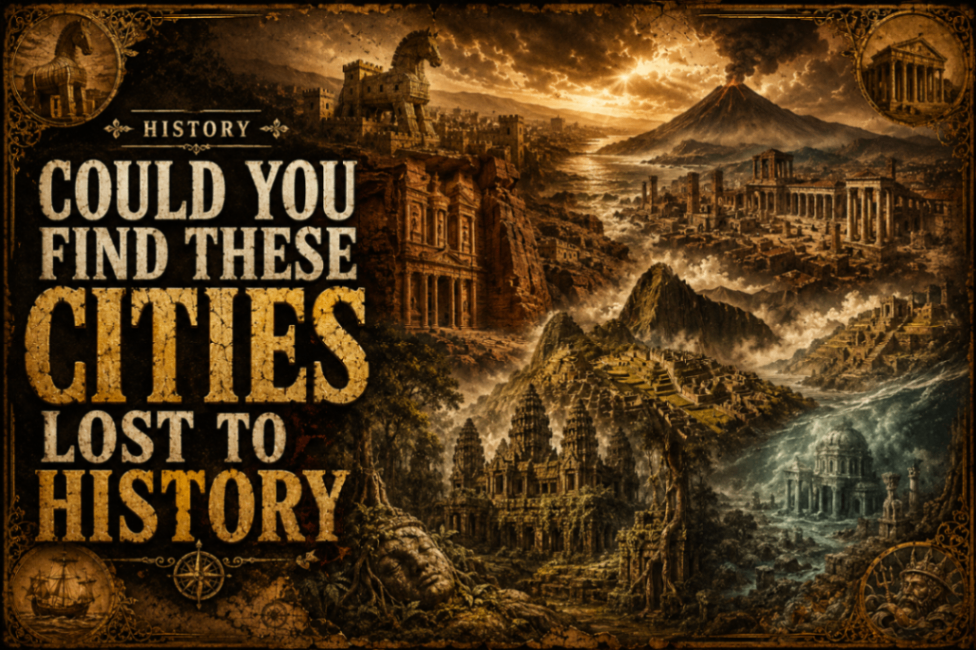
Questions in this quiz: Lost Cities of the World
Cities once thought lost. Troy, Pompeii, Herculaneum, Atlantis (legend), Machu Picchu before 1911, Petra before 1812, Angkor before the 19th century, Pavlopetri, Cahokia, Great Zimbabwe.
- The German businessman who excavated the site believed to be Troy in the 1870s was guided primarily by which source? — Options: Ottoman survey maps of Anatolia, Homer's Iliad, Herodotus's Histories, Strabo's Geographica
- Pavlopetri, often called the oldest known submerged city, lies off the coast of which country? — Options: Greece, Egypt, Italy, Turkey
- Which of these cities was buried not by ash fall but by a fast-moving flow of superheated mud and pyroclastic material that preserved wooden structures and food remains in remarkable detail? — Options: Pompeii, Herculaneum, Stabiae, Oplontis
- The Swiss explorer who in 1812 became the first European in modern times to reach the rock-cut Nabataean city later known as Petra disguised himself as which of the following? — Options: A Bedouin trader, An Ottoman tax collector, A Muslim scholar on pilgrimage, A Greek Orthodox monk
- Before Hiram Bingham's 1911 expedition publicised Machu Picchu, the site was being actively used by whom? — Options: It was completely abandoned and overgrown, Local Quechua farmers who lived and grew crops on its terraces, A community of cloistered Catholic nuns, Peruvian army patrols using it as a lookout
- Cahokia, the largest pre-Columbian city north of Mexico, was located near the modern site of which present-day American city? — Options: Memphis, Tennessee, St. Louis, Missouri, Cincinnati, Ohio, Nashville, Tennessee
- Which Swiss explorer rediscovered the rock-cut city of Petra in 1812?