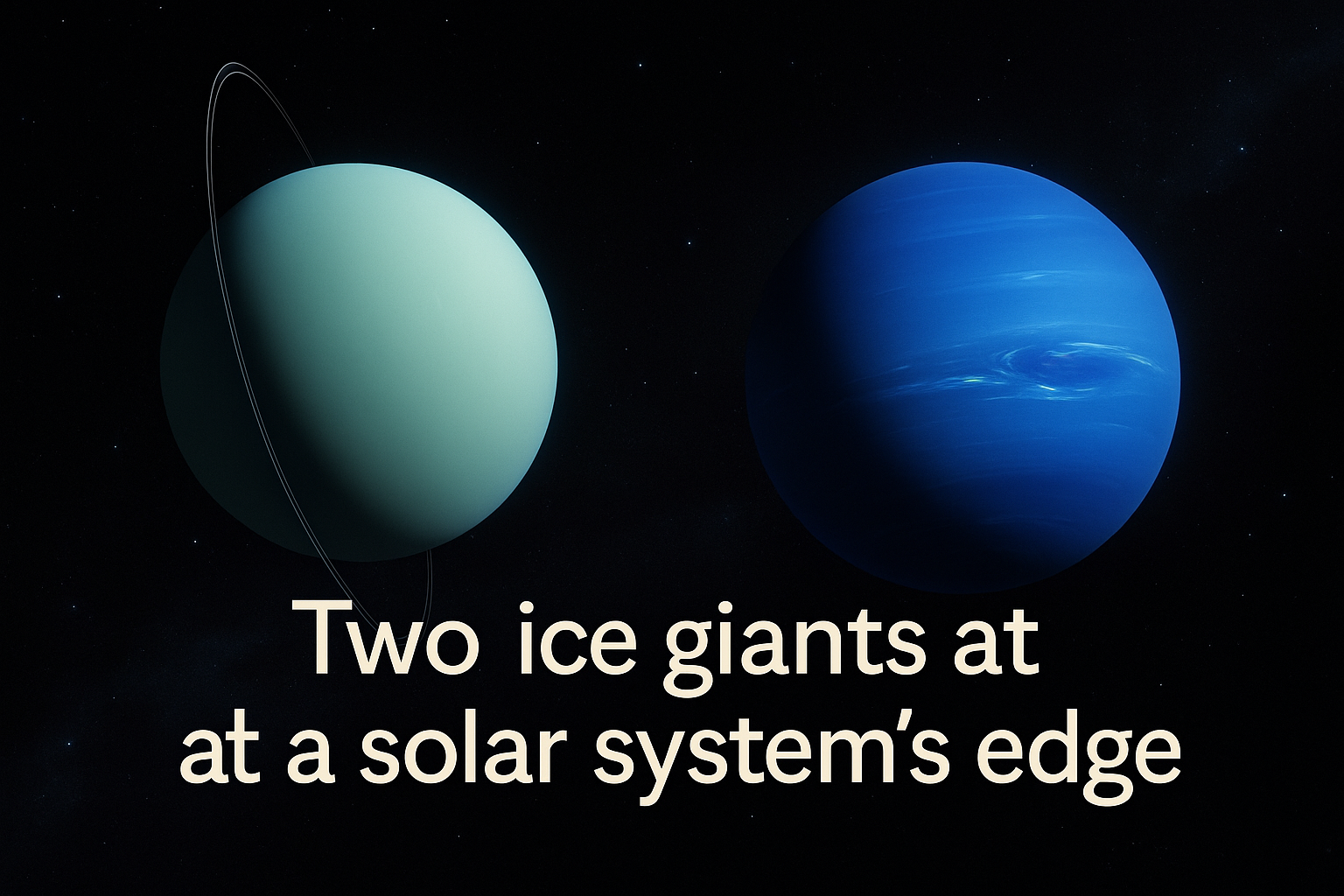
Questions in this quiz: Uranus and Neptune
The ice giants. Uranus's sideways axial tilt, methane atmosphere, Miranda's chaotic terrain. Neptune's Great Dark Spot, supersonic winds, Triton's retrograde orbit, and Voyager 2's only flybys.
- Voyager 2 made its closest approach to Neptune in August 1989. Approximately how long after launch did this flyby occur? — Options: About 6 years, About 9 years, About 12 years, About 15 years
- Uranus's axis is tilted roughly 98 degrees from its orbital plane. What is the leading hypothesis for how this extreme tilt originated? — Options: Tidal locking with its largest moon Titania, A giant impact with an Earth-sized body in the early solar system, Resonant gravitational interaction with Neptune, Atmospheric drag during planetary migration
- Miranda's surface features a roughly 20-kilometer-high cliff face, one of the tallest known in the solar system. What is this feature called? — Options: Ahuna Mons, Verona Rupes, Olympus Mons, Caloris Planitia
- Neptune's winds are the fastest measured on any planet in the solar system. Roughly what peak wind speed did Voyager 2 record? — Options: 800 km/h, 1,500 km/h, 2,100 km/h, 3,400 km/h
- Triton orbits Neptune in a retrograde direction. What does this strongly suggest about its origin? — Options: It formed in situ from Neptune's circumplanetary disk, It is a captured Kuiper Belt object, It is debris from a collision between Neptune and a protoplanet, It was ejected from Uranus's system during planetary migration
- When the Hubble Space Telescope imaged Neptune in 1994, what had happened to the Great Dark Spot observed by Voyager 2? — Options: It had migrated to the southern polar region, It had grown to cover nearly half the planet's disk, It had disappeared entirely, It had split into two smaller spots
- Triton's surface features active geyser-like plumes. What are these plumes believed to primarily eject? — Options: Liquid water, Molten silicate lava, Nitrogen gas with dark dust, Sulfur dioxide vapor